Posts

Showing posts with the label Reading

Week 14 Reading Notes
Image
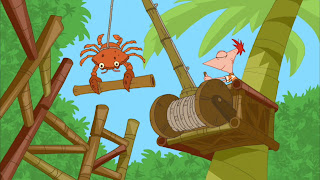
Week 14 Reading Notes The Crab and the Crane Phineas operates the crab crane,  Wikipedia There is a place that is going through a draught and it is affecting all of the animals, including the fish in the pond. A crane offers to fly the fish to a deeper pond that is deep in the woods. The fish are skeptical, and accuse the crane of wanting to eat them. So, the crane offers to take one of the fishes that is trustworthy to the deep pond and then bring him back to prove to the other fish that his offer is honest. So the crane took a fish to the new pond and it was everything that the crane had promised. So when he returned, all of the other fish wanted to go. So, the crane proceeded with this plan to eat all of the fish. Then, after all of the fish had been eaten, a crab remained in the pond. He asked the crane if he could be carried to this new pond. The crab insisted on being able to hold the crane by the neck, which the crane eventually agreed to. The crane then broug...


Week 13 Reading Post: The Hypocritical Cat

Image
The Hypocritical Cat W. Robinson There was a cat that lived by a river that wanted to eat a group of rats that lived in holes around the river. However, he knew that he could not attack all of them because most of them would run away. He decides to trick them by standing on one leg outside of their holes.  This story is very similar to the one about the wolf tricking the rats to trust him so that he could eat them. The cat pretends to worship the sun, and during his worship the troop would file past him and he would eat the one in the rear. This is extremely similar to the wolf and the rats story. This plan worked until the leader of the rats noticed and decided that he was going to take on the cat. Since this one is so similar to a story that I have already focused on, if I do choose to do this one then I will drastically change this story Maybe combine the two? Source:  The Giant Crab, and Other Tales from Old India

Week 13 Reading Notes: The Giant Crab

Image
The Giant Crab Pokémon Wiki:  Krabby This story revolves around a massive crab that lived alone in a lake that was up in the mountains This lake was the water source for all of the surrounding animals, and these animals often fell prey to the giant crabs claws The, some elephants decided to bring the crabs reign of terror to an end. So they hatched a scheme. The crab attacked one of the elephants. Meanwhile, the elephants wife begged the crab to stop attacking her husband. This caused the crab to stop what he was doing and then he began to flirt with the female elephant. When the crab went in for a kiss, the elephant jumped on the crabs back. He began to jump up and down until the crab was crushed and killed Now all of the animals were able to drink at the lake again without fear of the giant crab killing them. Source:  The Giant Crab, and Other Tales from Old India

Week 12 Reading

Image
Epified: Krishna Radha's Love: For the Love of Krishna When Krishna was a boy, he would sit by the river and play his flute while his cattle would graze All of the girls loved this Krishna only had eyes for Radha, however. During their childhood together, Krishna covered Radha's face with black paint, so that she would be as dark as he was One day, the other woman tricked Radha into drinking scalding hot milk. They told her that Krishna wanted her to do it. To everyone's shock, Radha suffered no blisters on her tongue. Krishna, however, suffered from the blisters that should have been hers. Radha saved Krishna's life by allowing him to drink the water that she used to wash her feet. Source:  Epified: Krishna

Week 12 Reading, Part B

Image
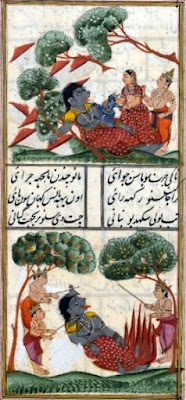
Epified: Krishna Putana Top Panel: Krishna killing Putana Bottom Panel: The people of Vraj cutting Putana's body and burning her body. Source: Wikipedia Putana was a demoness that was sent by Kamsa to kill Krishna while he was a baby. Putana was known as the killer of infants. Putana is also considered to be Krishna's foster mother because she breastfed him. Although it was only for a moment, breast feeding is considered the supreme act of maternal devotion. Putana disguised herself as a beautiful woman and the town took her to be the manifestation of Lakshmi. Krishna's foster mother also fell for this trick and allowed Krishna to sit on Putana's lap. Putana then began breast feeding Krishna after covering her breasts in poison in an attempt to kill Krishna. However, Krishna began to consume Putana's life through her breast. As she runs from the house, screaming in pain, she died in the center of town and took on her demonic form. Source:  Epif...

Week 12 Reading Part A

Image
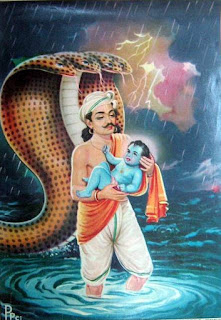
Epified: Krishna, Part A Vasudeva carrying the newborn Krishna to Nand's house in Gojul via the river Yamnuna Wikipedia Kanz was told by a booming voice from the sky that the 8th son of one specific family would grow up and be the reason for his death In a rage, Kanz tried to killed his cousin and his wife, thinking that that would solve the problem He decided to throw them into prison rather than kill them He also killed every one of their children, totally in 6 A goddess transferred her 7th child into a different place so that it wouldn't be killed So, when she gave birth to her next child, Kanz killed it thinking that his task was done and that he had killed the child that would be his downfall When her true 8th child was born, it was the incarnation of Vishnu Source:  Epified: Krishna

Week 11 Reading Notes: The Tricky Wolf and the Rats

Image
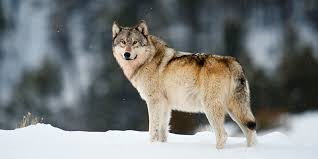
The Tricky Wolf and the Rats Gray Wolf,  Defenders of Wildlife There was a large clan of rats, led by a chief named Big Rat, and they lived in the forest. A Tricky Wolf sees the large group of rats and begins to plot on how to catch them so that he could eat them. The Wolf begins to pretend that he is lame and cannot walk on his front leg so that the rats will think that he is not a threat. He also keeps his mouth open so that he can "drink the air", claiming that that is his only source of food. The Big Rat begins to feel sorry for the wolf and he and all the other rats would visit him once a day. But every time they came to visit, the wolf would eat one rat and would pretend that nothing had happened. When the rats finally began to notice their group getting smaller they immediately blamed the wolf, so they laid a trap. When they all went to visit the Chief Rat went last and when the wolf tried to eat him he was not quick enough and missed, blowing his cover. T...

Reading Notes Week 10: Babbitt, Jataka Tales, Part B

Image
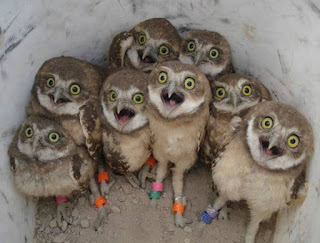
Why the Owl is not King of the Birds The story begins by comparing owls and crows Crows torment the owls during the daytime, while owls try and kill the crows at night In the beginning, each species chose a king for themselves, and all of the birds gathered together to elect a king. They decided to elect the owl as the king of the birds. All of the birds decided on the owl except for one old crow, who said that the owl looks to cross and angry to be king. Ever since, the crows and owls have been enemies. The Turtle Dove was later chosen to be king of the birds. U.S. Department of the Interior Source:  Babbitt, Jataka Tales

Week 10 Reading Post: Babbitt, Jataka Tales, Part A

Image
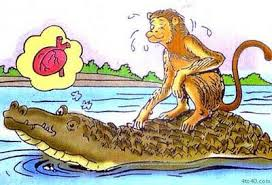
The Monkey and the Crocodile A elder crocodile asks a younger crocodile to get the heart of a young monkey for him to eat, so now the crocodile has to figure out how to trick one of the crafty monkeys. He decides to offer one of the monkeys a ride on his back to the other side of the river, where there is a lot of ripe fruit. The story mentions that the crocodile is stupid, but the greed of the monkey also plays a key factor in this story. Once the monkey is on the crocodiles back and they are about halfway across the river the crocodile announces, very stupidly, that he is going to drown the monkey so that his mother can eat his heart. But the crafty monkey then tells the crocodile that he does not have his heart with him, so that even if the crocodile does drown him, he will not get the heart. So now, the crocodile thinks that they must go back to the shore so that the monkey can get his heart. The monkey flees, but the crocodile finds him farther down the river. The two have ...

Reading Notes: Epified, The Mahabharata Part 2

Image
The Mahabharata Son of the Sun: Kunti, raised by her uncle (a king), befriends the curse laying sage that everyone fears. However, Kunti does not fear him and engages him in conversation. When the sage left he gave Kunti a mantra, which allowed her to summon any god she wanted. She tests it and the Sun god appeared before her. After a blinding light, Kunti is left with a beautiful son in her hands. Unable to claim him (since she was unmarried and had no way to explain the baby) so she sent him adrift in a basket along the river. Epified: Mahabharata

Reading Notes Week 9: Epified, The Mahabharata

Image
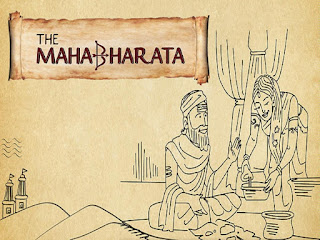
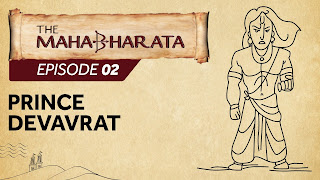
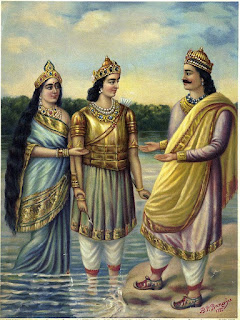
Epified Point of view that it is an account of how Karma functions. story begins similarly to what was read before, with the drowning of the kings children. Shantanu finds a young archer taming the river with arrows, only to find out that it was his long lost 8th son, Bhishma. Bhishma decides to go to the father of the girl that Shantanu has fallen in love with, in order to talk some sense in him. quite ambitious for a fisherman Bhishma vows to never marry or sire children, for the sake of his fathers happiness. Although, this dismays his father. *The animated short stories are not only easier to digest and easy to listen to, there is a lot more entertaining to have these stories read aloud than reading them yourself. The animators and narrators did a fantastic job with this Epified: Mahabharata Videos

Reading Notes: Mahabharata, Part C

Image
Reading Notes Source:  Public Domain Edition of the Mahabharata The Court of King Virata Finally, the 12 year exile of the Pandava's has ended and they begin their one year disguise. They spend this disguised in the court of King Virata. Ironically, Yudhishthira's role is as the kings dice companion, Bhima is disguised as the cook, and Nakula and Sahadeva play roles with cattle. Arjuna takes the name of Brihannala and lives as a eunuch, and Draupadi is the queen's hairdresser named Sairandhri. While in disguise, Draupadi is raped by Kichaka, the queen's brother. Bhima avenges her by squeezing Kichaka to death, almost ruining the groups chances of completing their year in disguise.  Brink of War Once again, the Pandavas find themselves on the brink of war and are bidding for peace. All Yudhishthira asks Hastinapura is that he be given 5 villages (instead of half of the kingdom which was the originally negotiating terms) in order to avoid war. The section ends wi...

Reading Notes: Mahabharata, Part B

Image
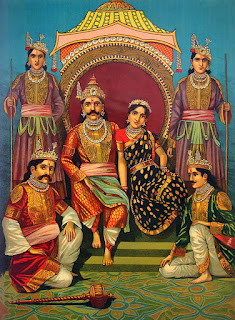
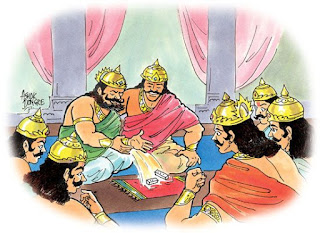
Mahabharata, Part B: The Pandavas at Indraprastha: Duryodhana's hate for the Pandavas only grows when he finds out they are still alive, yet, Dhritarashtra does not share the same level of hatred for the Pandavas as Duryodhana does. Dhritarashtra is given two different kinds of advice; make peace or go to war. The conflicting advice confuses Dhritarashtra, so he decides to give them part of his kingdom so they will return.  The Dice Games: During a game of dice, Yudhishthira loses everything that he owns to Shakuni. This not only includes his possessions and property, but also his brothers as well as himself. He then gambles, and loses, Draupadi, although she argues that she could not be gambled by someone who just lost ownership of himself. As Draupadi is ordered to undress, she calls upon Krishna for help. Help arrives in the form of layers of sari's that Draupadi is now wearing. Every time she takes one off, another appears. Later, Duryodhana invites Yudhishthira t...

Reading Notes: Mahabharata, Part A

Image
Mahabharata, Part A Shantanu and Ganga: Shantanu is the king and ruler of the city of Hastinapura, and he falls in love with a women that he meets along the Ganges river. [In a bold move] Shantanu asks this woman to marry him and she agrees, as long as he never questions what she does [yeah, that's a great idea]. Then, she begins to drown their new born babies. Before she can drown the eight baby, Shantanu finally interjects. His wife then reveals that she is the reincarnated form of the river Ganga, and is tasked with giving birth to eight children, who are the reincarnated forms of the Vasus, who are gods. They are being punished with this reincarnation and immediate death for stealing Vashishtha's cow. Drowning them returns the gods to heaven. Ganga takes the eight baby and disappears in the river. Later, she returns the child as an adult to Shantanu. The child's name is Bhishma. Shantanu and Satyavati: Shantanu meets a fisherman's daughter named Satyavati a...

Reading Notes: Narayan's Ramayana, Part D

Image
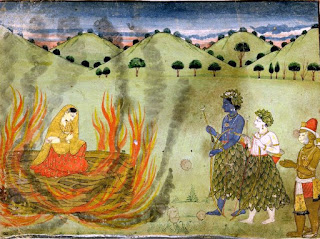
Narayan's Ramayana Part D: Hanuman find Sita: Hanuman searches for Sita across the ocean and finds himself in Lanka. He finds Sita guarded by demons. Hanuman then allows himself to be captured and is brought before Ravana. Hanuman tells Ravana that Rama is looking for Sita and that Ravana should just give up. This leads to a fight, which no one really wins (Hanuman destroys the city, but it is almost immediately rebuilt). Ravana is advised to release Sita, but like all bad guys, he rejects this advice. Rama Crosses the Sea: Rama orders the sea god to help him cross the ocean to Lanka, where Sita is held captive. Rama launches an attack on Lanka, and with the help of other gods like Indra, Rama is able to gain the upper hand. Finally, Rama and Ravana fight each other. Rama and Ravana circle the earth in battle and they use supernatural weapons against one another. Rama finally wins the battle, and Rama orders a massive funeral for Ravana. Rama Tests Sita: Rama tests Sit...

Reading Notes: Narayan's Ramayana Part C

Image
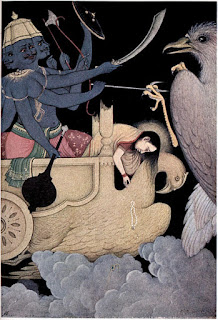
Reading Notes: Ramayana Part C Ravana abducts Sita: After Sita hears Rama call for help while hunting the golden deer, she sends Lakshmana to go help him, leaving Sita all by herself. Ravana then approaches Sita disguised as an old hermit, reveals himself (for some dumb reason), and then steals her away. Jatayu and Ravana: Jatayu, and old friend of Dasharatha, tries to rescue Sita, but is defeated. When Rama and Lakshmana return, Jatayu is dying and fills them in on the events that they have missed. However, Jatayu dies before he can tell them where Ravana has gone. Rama and Sugriva: We learn that way before the events in this story, Vali had helped churn the nectar from the ocean, earning the gratitude and gifts of the gods (fighting powers). The demon Mayavi challenged Vali, which Vali won. After this, a fight broke out between Vali and Sugriva, Vali won and took Sugriva's wife, and Sugriva went into exile in the mountains. Rama feels compassion for Sugriva, and is ...

Reading Notes: Narayan's Ramayana, Part B

Image
Ramayana, Part B Notes: Rama's Exile: After Rama goes into exile, his people become distraught and Lakshmana becomes angry at their sudden exile. Soon after Rama, Lakshmana, and Sita depart from the city, Dasharatha dies. Bharata: During all of the previous events, Rama's brother Bharata is away in his grandfathers kingdom. Messengers are sent to get Bharata, but he isn't given any reason as to why he must now leave. Bharata soon finds out about Rama's exile, his fathers death, and his mothers plan to make him king; this enrages him. He begs Rama to return, Rama refuses, and Bharata reigns as regent until Rama's return. Ravana's Sister: While hiding in the forest, Rama meets Shurpanakha, a beautiful women who lies to Rama and says her name is Kamavalli. She declares her love for Rama and takes on her new rival, Sita. Lakshmana mutilates Shurpanakha and brings her to her step-brother, Kara, who commands the demon army of the forest. Battle ensues but...

Reading Notes: Narayan's Ramayana Part A

Image
Reading Part A King Dasharath Kingdom of Koshala is described as a very beautiful place Capital city is Ayodhya Dasharath is does not have a son; i.e. no heir Dasharatha's Sons Dasharatha preforms a horse sacrifice in order to receive an heir After the sacrifice, the gods (Brahma, Vishnu, Shiva, and Indra) promised that 4 sons would be born to Dasharatha Rama: Avatar of Vishnu Vishnu is born on earth as a human in order to defeat the demon king Ravana Vishnu is born as Rama (he is actually all four sons), the son of Dasharatha Vishvamitra Vishvamitra, a brahmarishi, asks Rama Lakshmana to help him fight some demons that are interfering with his sacrifices  They use swords and bows as weapons Thataka Rama engages in battle for the first time He fights a female rakshasa After winning the battle, he receives supernatural weapons that allow him to converse with the spirits of the weapons Bhagiratha and Ganga While with Vishvamitra, Rama is told s...

Reading Notes: The Foolish, Timid Rabbit

Image
Reading Notes... Jataka Tales by Ellen C. Babbit The Foolish, Timid Rabbit I liked this story on several different levels. For one, I think its a good example of the herd mentality. People have a tendency to follow what most people are doing and consider "the norm" to be the best, simply because everyone else is doing it. They initial hysteria seems to stem from the rabbits own paranoia. But then that paranoia is confirmed when the coconut falls. The rabbit was waiting for the world to begin to fall apart and the moment that it seemed like it was indeed falling apart it refused to stop and think of other possibilities, it just went with the first thing that popped into his head (sort of a case of confirmation bias) and ran. This then leads to more animals simply following what everyone else is doing until the lion sets the record straight. It reminds me of one of my favorite Mark Twain quotes: "Whenever you find yourself on the side of the majority, it is time to ...